The Future of Text-to-Speech: What's Coming in 2026 and Beyond
Two years ago, AI voices still sounded robotic. Today they're nearly indistinguishable from humans. What's next? Here are my predictions for text-to-speech technology in the coming years — based on current developments and conversations with industry experts.
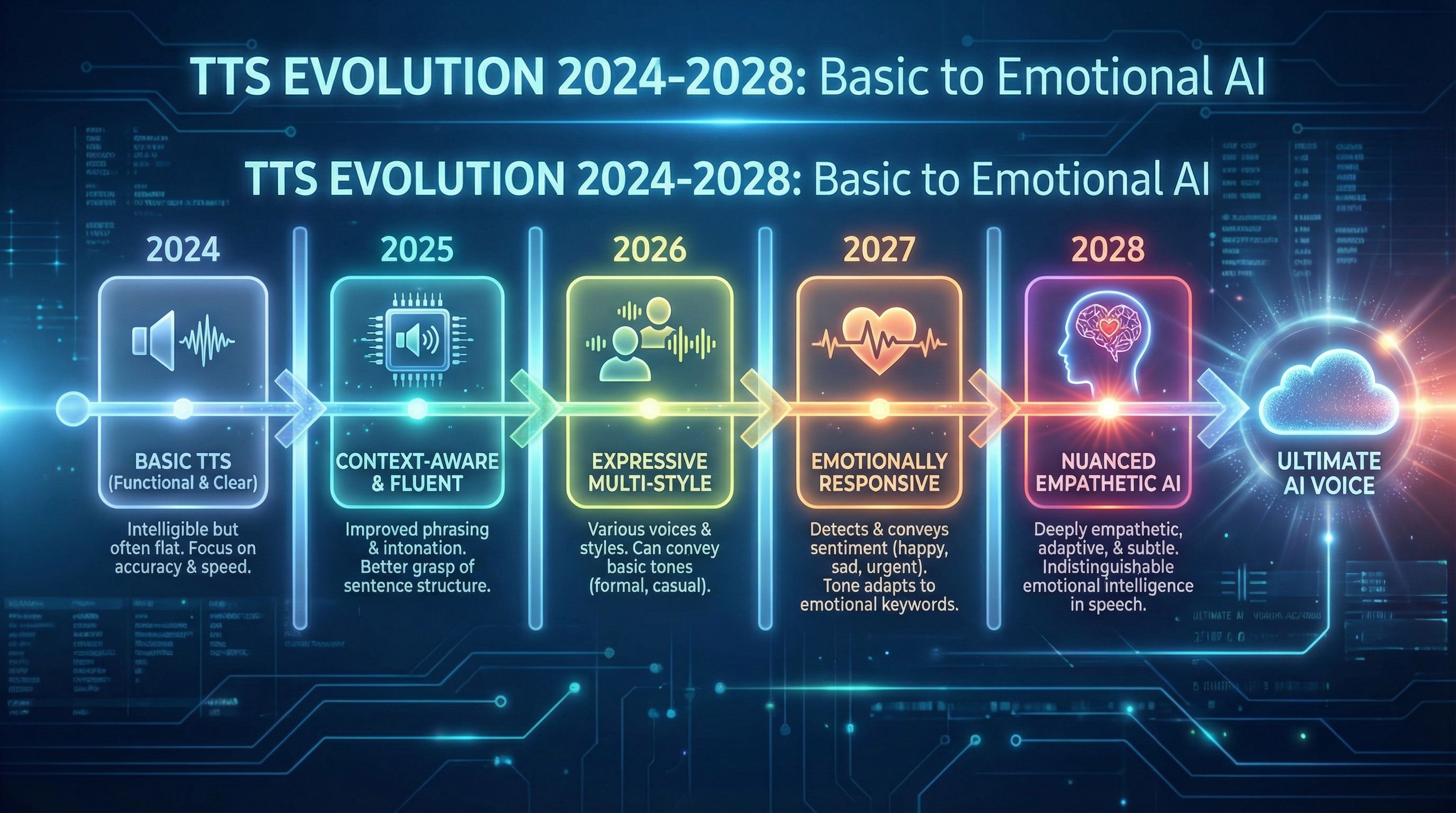
Where We Stand Today (2025/2026)
The current state with ElevenLabs and similar services is already impressive:
- Near-human quality: In blind tests, many people can't distinguish AI voices from real ones
- Emotional control: Voices can sound sad, excited, calm, or ironic
- Voice cloning in minutes: 30 seconds of audio is enough to clone a voice
- Multilingual: A cloned voice can speak in 29+ languages
- Real-time synthesis: Under 200ms latency enables conversational applications
The pace of development has been breathtaking. In 2022, even the best AI voices sounded mechanical. Today I regularly produce content where nobody questions whether I recorded it myself.
Trend 1: Hyper-Personalization
The future belongs to personalized voices for every use case. Imagine:
- E-Commerce: Product descriptions spoken in your favorite brand's voice
- E-Learning: An AI tutor whose voice and speaking style adapts to your learning type
- Gaming: NPCs with unique, dynamically generated voices based on their personality
- Advertising: Personalized audio ads that include your name and local references
ElevenLabs is already working on "Voice Design" — the ability to generate entirely new voices from descriptions. "A warm male voice, 40 years old, slight Southern accent" will soon be enough to create a unique voice.
Trend 2: Conversational AI Becomes Standard
The next generation of voice assistants won't play pre-recorded responses. Instead:
- Natural pauses: The AI says "um" and thinks pauses like a human
- Interruptions: You can interrupt mid-sentence without confusing the AI
- Emotional response: The voice adapts to your mood
- Context memory: The AI remembers previous conversations
Technically we're almost there. The challenge is no longer speech synthesis but latency. Current ElevenLabs models already achieve under 200ms — fast enough for natural conversations.
Trend 3: Universal Speech Translation
Für Entscheider im Mittelstand
Vom KI-Interesse zum kontrollierten ersten Pilot.
Im AI-Agenten Blueprint Sprint priorisieren wir Ihren ersten Einsatzfall und definieren Datenzugriffe, Freigaben, Verantwortlichkeiten und einen 30-Tage-Plan.
The combination of speech-to-text, translation, and text-to-speech already enables real-time translation. But the future goes further:
- Lip sync: Videos automatically adjusted so lip movements match the translated language
- Cultural adaptation: Not just words are translated, but idioms and cultural references too
- Voice preservation: Your cloned voice speaks perfect Japanese — with your timbre and mannerisms
For content creators, this is revolutionary. A German YouTube video can automatically be made available in 30 languages — with consistent voice and professional quality.
Trend 4: Audio Becomes the New Interface
Text interfaces dominate today. But audio has massive advantages:
- Hands-free: Perfect for driving, exercising, cooking
- Multitasking: Listen while doing something else
- Accessibility: For people with visual impairments or reading difficulties
- More emotional: Voice conveys nuances that text can't
We'll see more audio-first applications. Newsletters as personalized podcasts. Documentation as audio guides. Emails read aloud. The technology is ready — now applications need to follow.
Trend 5: Ethical Regulation Is Coming
With great power comes great responsibility. The ability to clone any voice raises serious questions:
- Deepfakes: Fake audio recordings of politicians, CEOs, celebrities
- Fraud: Scam calls with cloned family member voices
- Consent: Who gets to use my voice for what?
- Job market: What happens to professional voice actors?
The EU is already working on regulations under the AI Act. ElevenLabs has proactively implemented safeguards — voice cloning requires verification, and generated audio includes watermarks. But the industry needs to do more.
My Predictions for 2027-2030
Short-term (2027)
- Voice cloning becomes as normal as photo editing
- At least 30% of all podcasts use AI elements
- First "synthetic speakers" achieve celebrity status
Medium-term (2028-2029)
- Real-time translation built into standard video conferencing tools
- Audio interfaces overtake text in many areas
- Regulations require labeling of synthetic voices
Long-term (2030+)
- Personalized audio companions are ubiquitous
- Language barriers effectively eliminated
- "Natural" human voices become a premium feature
What This Means for You
If you're a content creator, entrepreneur, or developer, you should get started now:
- Experiment today: Sign up at ElevenLabs and try the technology
- Secure your voice: Create a professional voice clone for future projects
- Think in audio: Which of your text content could work better as audio?
- Stay ethical: Only use voice cloning with consent and label synthetic voices
Conclusion: The Audio Revolution Has Begun
Text-to-speech is no longer a future technology — it's here, it's good, and it's only getting better. The question isn't whether but how quickly this technology will transform our communication.
For me personally, ElevenLabs has already changed how I produce content. Instead of spending hours in a recording studio, I can focus on writing — and let the AI handle the rest.
The future of text-to-speech technology isn't just technically fascinating — it's practically relevant for anyone working with voice and audio. And it's coming faster than most people think.
🚀 Ready for the Future?
Start today with the best TTS platform and stay ahead of the competition.
Try ElevenLabs free →Für Entscheider im Mittelstand
Vom KI-Interesse zum kontrollierten ersten Pilot.
Im AI-Agenten Blueprint Sprint priorisieren wir Ihren ersten Einsatzfall und definieren Datenzugriffe, Freigaben, Verantwortlichkeiten und einen 30-Tage-Plan.
Tags
About the Author

Jan Koch
KI Experte, Berater und Entwickler. Ich helfe Unternehmern und Entwicklern, KI effektiv einzusetzen - von der Strategie bis zur Implementierung.
Related Articles
ElevenLabs Tutorial for Beginners: From Signup to Pro
New to ElevenLabs? This tutorial walks you through everything from signing up to creating your first professional voice-over.
5 min
ElevenLabs vs Murf vs PlayHT: The Ultimate Comparison 2026
Which text-to-speech service is the best? I compare ElevenLabs, Murf AI, and PlayHT on quality, price, and features.
3 min
The Future of Text-to-Speech: What 2026 and Beyond Holds
Text-to-speech has evolved dramatically. From robotic voices to human-like speech. Here is what 2026 brings.
3 min